Swollen Face From a Tooth? How to Tell If It's a Dental Emergency in Tustin

A swollen face from a tooth usually signals a dental abscess, a pocket of infection at the root or in the gum. It needs treatment the same day. Go to an emergency room instead if you have trouble breathing or swallowing, or a fever and facial swelling when your dentist cannot be reached.
Quick Answer
Swelling plus trouble breathing or swallowing: ER now. Swelling with throbbing pain, a bump on the gum, or a bad taste: call a dentist today.
Key Takeaways
- Facial swelling from a tooth is usually an abscess, and an abscess does not heal without treatment.
- Trouble breathing or swallowing is a 911 or ER situation. So is a fever with facial swelling if you can't reach a dentist.
- If the pain suddenly eases after the swelling shows up, the abscess may have drained. You still need treatment.
- Until you're seen, use a cold compress on the cheek and warm salt-water rinses. Skip heat, and don't squeeze anything.
- Treatment usually means draining the infection, then saving the tooth with a root canal or removing it.
Most people notice it in the mirror first. One cheek looks fuller than the other, the jaw feels tight, and the tooth that has been nagging for a week or two suddenly makes sense.
Swelling is the point where a toothache stops being something to schedule around. At Transformation Dental Partners in Tustin, it is one of the problems we move to the front of the line, and our emergency dentistry page explains how same-day visits work at our office.
Home care comes later in this guide. First, the part that matters most: figuring out where you should be going right now.
Is facial swelling from a tooth an emergency?
Yes, though not always an emergency-room one. Swelling that starts at a tooth means infection has moved past the tooth itself, and an abscess will not go away without treatment. The real question is how fast you need care: within hours at a hospital, or the same day at a dental office.
This table sorts the common situations. If you fit more than one row, go with the most urgent.
| What you notice | Where to go | How soon |
|---|---|---|
| Trouble breathing or trouble swallowing | Call 911 or go to the ER | Now |
| Fever and facial swelling, and you can't reach a dentist | Emergency room | Now |
| Swelling spreading under the jaw or into the neck | Emergency room, then your dentist | Today, without waiting to see if it improves |
| Swollen cheek or gum with throbbing pain, a pimple-like bump on the gum, or a salty or foul taste | Emergency dental visit | Same day |
| Mild puffiness a day or two after an extraction or other dental work, getting better | Call the office that did the work | Next business day, sooner if it gets worse |
Mayo Clinic's guidance on tooth abscess draws the line in the same place. Fever with facial swelling, when your dentist can't be reached, is an emergency-room trip, and so is any trouble breathing or swallowing, because those signs can mean the infection has moved deeper into the jaw, throat, or neck.
Hospitals see a lot of this. The American Dental Association estimates more than 2 million emergency department visits every year for dental pain. An emergency room can stabilize you and treat a spreading infection, but the source is still inside the tooth, and that part needs a dentist afterward. Our earlier post on four types of dental emergencies that need immediate care covers the other situations that belong in the same-day category.
What causes a swollen face from a tooth?
Most tooth-related swelling traces back to bacteria getting somewhere they shouldn't. Deep decay, a crack, or older dental work can let bacteria into the pulp at the center of the tooth, which leads to an abscess at the root tip. Gum infections and partly erupted wisdom teeth account for many of the rest.
The usual sources look like this:
- A periapical abscess forms at the tip of the root, most often from an untreated cavity, an injury, or earlier dental work, according to Mayo Clinic.
- A periodontal abscess forms in the gum beside the root, often where gum disease has opened a pocket.
- A wisdom tooth that has only partly broken through can trap food and bacteria under the gum flap over it.
- Swelling after an extraction or surgery is often normal healing, as long as it peaks early and then improves.
The cavity at the start of the most common version is frequently painless for months. Decay doesn't hurt much while it's in the enamel. By the time it reaches the nerve, the tooth has usually been ready for a filling for a long while, and nobody knew.
Why did the pain ease once the swelling showed up?
Because the pressure found a way out. When an abscess ruptures or drains, the pain can drop sharply, and many people take that as a sign the problem has passed. Mayo Clinic says the opposite: the infection is still there and still needs dental treatment, even if you feel much better.
This is the moment when appointments get cancelled. We understand why. Someone who couldn't sleep last night wakes up feeling fine, and a dental visit starts to seem like overkill.
The infection is still active, though. Left alone, an abscess can spread into the jaw and other parts of the head and neck. An upper tooth near the sinus can open a path into it. In rare cases, the infection reaches the bloodstream and becomes sepsis, which is life-threatening.
Feeling better is not the same as being treated.
What should you do at home until your appointment?
Keep the area cool and leave it alone. A cold compress on the outside of the cheek, warm salt-water rinses, and an over-the-counter pain reliever taken as the label directs can make the wait easier. None of these treat the infection. They only make the hours before your visit more bearable.
What helps:
- Hold a cold pack wrapped in a thin towel against your cheek for about 15 minutes at a time, with breaks in between.
- Rinse gently with warm salt water a few times a day.
- Take an over-the-counter pain reliever exactly as the package directs, and check with a pharmacist if you take other medications.
- Sleep with your head propped up on an extra pillow.
- Drink fluids and chew on the other side.
What to avoid:
- Heat on the outside of your face, including heating pads and warm compresses
- Squeezing, poking, or trying to drain a bump on your gum
- Placing an aspirin tablet against the gum, which can burn the tissue
- Leftover antibiotics from an old prescription
- Waiting out the weekend to see if it goes down
What happens at an emergency dental visit for swelling?
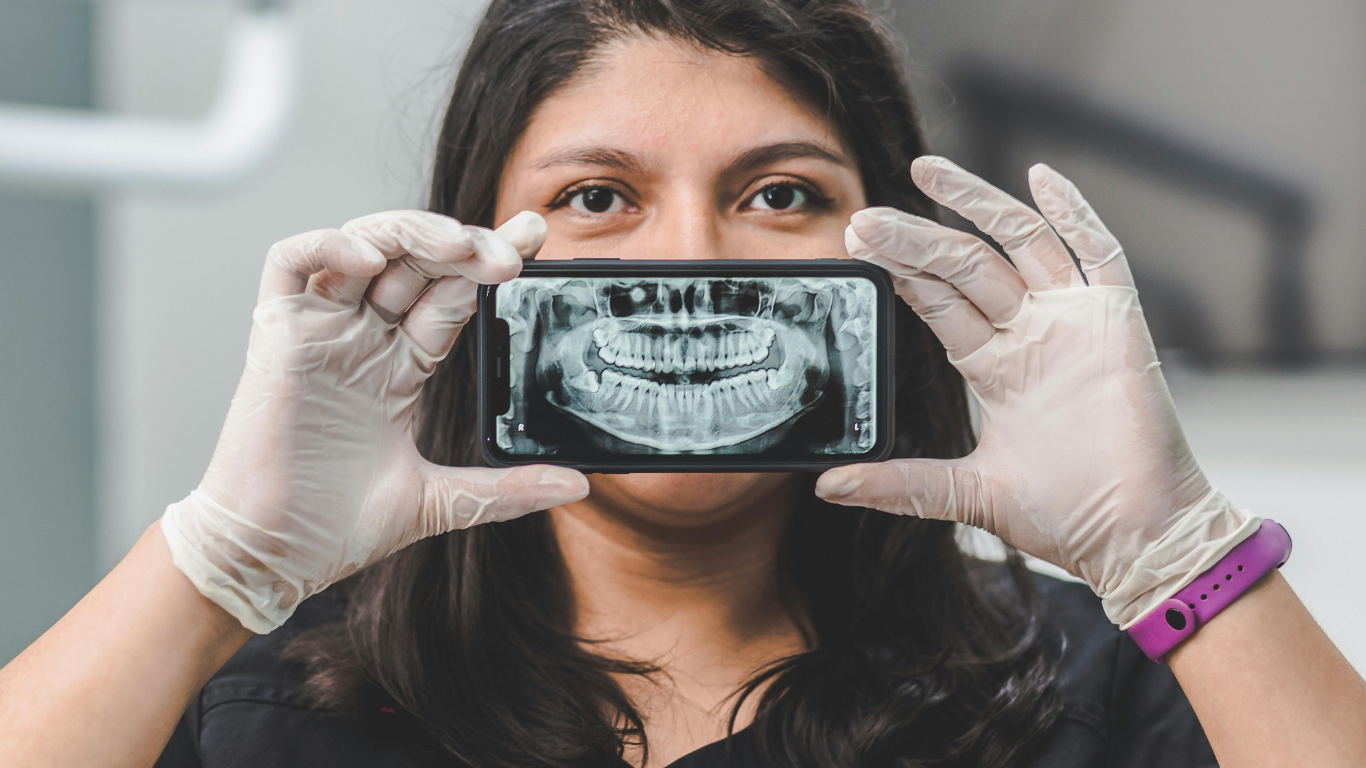
The first job is finding the source. Dr. Li examines the area, takes imaging to see what's happening at the root and in the surrounding bone, and then decides how to relieve the infection. That usually means draining it, and then either saving the tooth with a root canal or removing it.
Our office uses CBCT imaging, a 3D scan that can show infection around the roots, problems inside the tooth's pulp, and changes in the bone that a standard X-ray can miss. That picture shapes the plan.
If the infection is spreading, an antibiotic prescription may be part of treatment, but it supports the dental work rather than replacing it. Whether the tooth can be saved depends on how much structure is left and how far the infection has gone. Dr. Li is a member of the American Association of Endodontists, the professional group for root canal care, and
saving the natural tooth is usually the first option we look at.
The practice's emergency line is answered 24 hours a day, and emergency patients get same-day priority during office hours. If swelling starts on a Saturday or Sunday, call anyway. Weekend visits are available by appointment.
Frequently Asked Questions
Can a tooth infection make your face swell?
Yes. When bacteria from a decayed, cracked, or previously treated tooth reach the root, they can form an abscess, and the swelling can spread into the gum, cheek, or jaw. Facial swelling from a tooth is a sign the infection needs same-day dental care.
Should I go to the ER or the dentist for a swollen face?
Go to the ER if you have trouble breathing or swallowing, or if you have a fever and facial swelling and can't reach a dentist. For swelling without those signs, call a dentist for a same-day emergency visit, since the tooth itself still has to be treated.
Will a swollen face from a tooth go down on its own?
The swelling may come and go, but the infection behind it won't clear without treatment. If an abscess drains, pain and swelling can ease for a while, which makes it easy to put off care. The source of the infection is still in the tooth.
Can I use a warm compress on a tooth abscess?
Dentists generally advise against heat on the outside of a swollen face while an infection is active. A cold compress on the cheek, used in short sessions, is the safer choice while you wait for your appointment. Warm salt-water rinses inside the mouth are fine.
How fast can a tooth infection become serious?
It varies. Some abscesses stay contained for weeks, and others spread much faster. There is no reliable way to tell which kind you have by looking in the mirror, so treat new or growing facial swelling as a same-day problem.
Do antibiotics fix a tooth abscess?
Antibiotics can help control an infection that is spreading, but they don't remove its source. Dental treatment usually means draining the infection and then treating the tooth, either with a root canal or an extraction. The antibiotic supports that work rather than replacing it.
Who's Behind This Guide
Who's Behind This Guide
Transformation Dental Partners is led by Dr. Davin Li, DDS. Dr. Li was born and raised in Southern California and earned his undergraduate degree at the University of California, San Diego. He went on to the USC Ostrow School of Dentistry, graduating in the top 10% of his class in 2012.
He completed his residency at Rancho Los Amigos Rehabilitation Center in Downey. There, he pursued advanced training in treating patients who are medically, physically, or mentally compromised. He is also trained in Invisalign, dental implants, and CEREC.
Dr. Li is a member of the American Association of Endodontists, the professional organization for root canal care. His other memberships include the Special Care Dentistry Association, the Orange County Dental Society, the California Dental Association, and the American Dental Association. One day a week, he provides in-home dental care to medically compromised older adults in Los Angeles, Orange, and San Diego counties.
For more on recognizing an abscess, Mayo Clinic's
tooth abscess overview and the ADA's
MouthHealthy guide to dental emergencies are both worth bookmarking.
Swelling That Won't Wait?
A swollen face from a tooth needs same-day care, and the ER comes first only when breathing, swallowing, or a fever you can't get a dentist to look at are part of the picture.
Transformation Dental Partners is at 13372 Newport Ave, Suite G, Tustin, CA 92780.
We're open Monday through Thursday, 8:00 AM to 5:00 PM, and Friday, 8:00 AM to 1:00 PM, with Friday afternoons and weekends by appointment.